Latest Posts

  • Coolmore 2020 Fees- An Honest Appraisal- Part 1

    Coolmore has 25 flat stallions on their roster for 2020. I’ve assessed each of their fees as either representing good value, fair value or poor value. I can be honest because I don’t get paid to run full colour page ads for their stallions 🙂 Given the number of stallions, I will consider 12 stallions this week…

    Stallion 2020 fee (2019 fee)
    Australia €27,500 (€35,000)- (2011 by Galileo ex Ouija Board by Cape Cross)
    Verdict: Poor ValueOverpriced:

    Australia was a superior Derby winner out of an outstanding Oaks winner and a gorgeous mover and physical specimen. I thought he was the natural successor to Galileo but I was wrong. He has done respectably but the market is unforgiving and fickle and his progeny are showing too much stamina for our speed obsessed industry. His average winning distance is 11.9 furlongs and he has yet to sire a Group 1 winner. His sales median held up surprisingly well this year but unless he comes up with some superstars next year, he will be in trouble. He is a high risk proposition for any commercial breeder who would be looking to sell a yearling by him in 2022. In my view, given the risks involved he is overpriced and closer to €20,000 would be more appropriate.

    Calyx €22,500 (na)- (2016 Kingman ex Helleborine by Observatory)

    Verdict: Fair Value: (surprisingly)

    Surely €22,500 is too much for a horse who never won or even ran, in a Group 1? Surely its too much for a horse who was so fragile he only managed four runs in two seasons? Actually, its probably about right. Calyx was brilliantly fast and he is the first high profile son of Kingman to go to stud in Ireland. He comes from a strong Juddmonte family and he was precocious enough to win the Coventry at Royal Ascot. He is ticking the right commercial boxes ie fashionable, precocious and speedy and he should prove popular. That said I would expect the usual slight dip in fee in years 2,3 and 4 especially as more sons of Kingman hit the market. However as a purely commercial play (as opposed to someone looking to breed a racehorse), I think his fee is about right and can be justified.

    Camelot €40,000 (€40,000)- (2009 by Montjeu ex Tarfah by Kingmambo)

    Verdict: Poor ValueOverpriced:

    He stood for €25,000 for his first three seasons so he clearly has done something right. This season was a case of ‘close but no cigar’- Pink Dogwood was beaten just a neck in the Oaks and the following day Sir Dragonet started favourite for the Derby and was beaten just under a length. Currently he has 25 stakes winners (a creditable 5% of racing age offspring) and Camelot is the main hope for the Montjeu sireline on the flat. His yearling sales median dipped to 60000 guineas from 80000 guineas in the preceeding year. I would have expected a downward adjustment in his fee for 2020 to either €30000 or €35000.

    Caravaggio €40,000 (€35,000)- (2014 by Scat Daddy ex Mekko Hokte by Holy Bull)

    Verdict: Poor ValueOverpriced:

    Stood for €35,000 for his first two seasons and it is customary for fees to decrease not increase in the third season. He was an unbeaten two year old who won the Coventry and Phoenix Stakes and he defeated Harry Angel in the Commonwealth Cup at three. And of course, he was a son of Scat Daddy. It is this fact that accounts for the rise in his fee for his third season. People are assuming that he will replicate the success of Scat Daddy’s son, No Nay Never. He may well be a success but the risk/reward ratio for a third season sire doesn’t appeal to me.

    Churchill €30,000 (€35,000)- (2014 by Galileo ex Meow by Storm Cat)

    Verdict: Poor ValueOver Priced

    Churchill won seven consecutive races including 4 consecutive Group 1’s in 2016 and 2017. Alas, I still had to rewatch videos of his Guineas wins and Dewhurst to refresh the memory. That tells me that although he compiled an impressive cv, he lacked the star quality you would expect from a dual Guineas winner. His pedigree is typically high class Coolmore, with the plebian Airwave family having now arrived at the top table. His sister Clemmie also won a Group 1 in the Cheveley Park. He was high class, is well bred and has as good a chance as any third season sire of proving successful, but perhaps is a bit pricey compared with Gleneagles.

    Fastnet Rock €60,000 (€70,000) (2001 Danehill ex Piccadilly Circus by Royal Academy)

    Verdict: Poor ValueOverpriced (Massively)

    Verdict: His overall European record is nothing special given the quality of mares he received. Coolmore had hoped he would be a suitable consort for their many Galileo mares, but he didn’t really deliver. He can get a top notcher but even his best performers last season such as Torcedor, One Master and I Can Fly don’t exactly excite. His yearling median in 2019 was 51000 guineas so I don’t know how anyone thinks he is good value at €60,000. To me he is a €25,000 sire.

    Footstepsinthesand €15,000 (€10,000) (2002 Giant’s Causeway ex Glatisant by Rainbow Quest)

    Verdict: Poor ValueOverpriced

    He stood at €10,000 for 9 consecutive years before getting a 50% hike for 2020.  The justification was the emergence of two high class two year olds in Threat and Mum’s Tipple. This racecourse success also saw a rise in his yearling median to 27000 guineas from 20000 guineas. However both Threat and Mum’s Tipple were beaten in the Middle Park. That is the story of Footsteps, he is a reasonable stallion, who progeny are popular with trainers. However his best progeny fall short of being truly top class. He has a place in the market but his fee for the previous 9 seasons is about right.

    Galileo Private (Private) (1998 Sadler’s Wells ex Urban Sea by Miswaki)

    Verdict: Value 🙂

    We take his extraordinary results each year for granted. Another four classic winners in 2019 with Hermosa, Anthony Van Dyck, Sovereign and Search for A Song. The supporting cast included Circus Maximus and Japan. His fee has been private for over a decade now and supposedly over €500,000. At this level, the saying ‘if you have to ask the price, you can’t afford it’ springs to mind, so his actual fee is of little relevance to anyone who does their own shopping.

    Gleneagles €35,000 (30,000) (2012 Galileo ex You’resothrilling by Storm Cat).

    Verdict: Value

    What’s not to like? A dual Guineas winner, first past the post in 5 Group 1’s and out of a full sister to Giant’s Causeway. He has had a very nice first crop with Group 2 winners in Royal Lytham and Royal Dornoch and a Royal Ascot winner in Southern Hills. Overall there were an impressive 25 winners from 111 foals. In the sales ring he had a yearling median of 75,000 guineas. No superstars (yet), but a promising start and less of a risk than some of his studmates.

    Gustav Klimt €6,000 (€7,500) (2015 Galileo ex Massarrah by Danehill)

    Verdict: Overpriced

    ‘Only’ a Group 2 winner but placed in the Irish Guineas, St James Palace and Haydock Sprint Cup. His place on the Coolmore roster is due to the fact that his granddam is Rafha, the dam of Invincible Spirit and Kodiac. He may uphold the family tradition but those two tend to be influences for speed and precocity and I’m not sure about a son of Galileo doing likewise.

    Highland Reel €12,500 (€17,500) (2012 Galileo ex Hveger by Danehill)

    Verdict: Overpriced

    A really admirable racehorse. He ran 27 times. He won the Group 2 Vintage Stakes at two, won two Group 1’s at three, two Group 1’s at four and two Group 1’s at five. His successes included a King George, a Breeders Cup Turf, a Prince of Wales Stakes a Coronation Cup and a Hong Kong Vase. He is bred on the Galileo Danehill cross and his siblings include a Group 1 winner in Cape of Good Hope and an Irish Derby runner up in Idaho. We bemoan the fashion for speed and the lack of respect for soundness and toughness in our sires. However, I would be surprised if Highland Reel proves a successful flat sire. Nor does he appeal as an obvious choice for a commercially minded breeder. He lacked a striking turn of foot, improved with age and I expect him to be in Coolmore’s National Hunt division in a few years time!…

    Holy Roman Emperor €15,000 (€15,000) (2004 Danehill ex L’On Vite by Secretariat)

    Verdict: Fairly Priced:

    Romanised helped show his sire in a positive light with his victory in the Jacques Le Marois and a controversial defeat by Circus Maximus in the Moulin (the placings should have been reversed in my opinion). Overall though it was an unremarkable year on the track. He got a new two year old Group winner in Roman Turbo and Listed two year old winner in Piece of Paradise. His yearling median last year was a solid 31500 guineas and his stats of 85 stakes winners from 1746 foals of racing age is a healthy 5%. He can sire a top class horse, can get two year olds and deliver a return in the sales ring so I think it’s fair enough to price him at €15000.
    Please Leave a comment


  • Night of Thunder’s Lightning Start

    After a few years hiatus, I’ve found time to start writing again. My first topic is Night of Thunder who looks destined for the very top. His 2020 fee has been raised to €25,000, having covered at Dalham Hall for £15,000 for the past two years. He is likely to be heavily oversubscribed so you should call in whatever favours you can, to access him at that fee. He retired at a fee of €30,000 and if that was justified as an unproven stallion prospect, then €25,000 after a sensational first crop has to be the best value out there. If Coolmore stood him, he would be at least €50,000. I would be surprised, if he not covering at a six figure fee within a few years.

    Night of Thunder’s Racing Career:

    Night of Thunder made his debut in October 2013 , winning a 6 furlong Goodwood Auction Maiden by 6 lengths. He ran again two weeks later in a Listed race at Doncaster, this time by 3 lengths. Both races were on soft ground. It was a very satisfactory first season for a horse that Richard Hannon Snr was quoted as being all about his three year old season. He was best priced at 20-1 for the Guineas after his Doncaster victory.

    However that price didn’t look very attractive following the first run of his three year old campaign in the Greenham Stakes. He was beaten over four lengths by Kingman with no apparent excuses. He was 40-1 when he reopposed Kingman in the Guineas. Richard Hannon Jnr, had taken over the licence from his father and stable jockey Richard Hughes chose Toormore, leaving Kieran Fallon to get the ride. It was a very strong Guineas field but despite hanging near the finish, Night of Thunder won by half a length from Kingman. Subsequent Derby winner Australia was in third and the also-rans included Group One winners Charm Spirit, Toormore, Kingston Hill, The Grey Gatsby and War Command.

    Kingman won his classic in the Irish Guineas and got his revenge over Night of Thunder in the St James Palace, winning by a comfortable 2.5 lengths. Kingman added two more Group 1’s that season whereas Night of Thunder suffered three defeats. He didn’t stay in the Eclipse behind Mukhadram. He ran better back at a mile finishing a close third behind Charm Spirit in the Moulin and finishing his season with a close second again behind Charm Spirit in the QEII at Ascot. At the end of the season he was rated 5 pounds inferior to Kingman and a pound inferior to Charm Spirit.

    Night of Thunder was kept in training at four. The decision seemed a wise one when he won the Lockinge on his seasonal debut defeating his stable companion Toormore . The rest of the season was slightly underwhelming. He was fifth behind Solow in the Queen Anne at Royal Ascot and sixth behind Solow in the Sussex Stakes. His final career stats were 11 runs, 4 wins , 3 seconds and a third. He was a stakes winner at two, a classic winner at three and a Group 1 winner at 4. His Guineas win may have been slightly surprising and Kingman was a better horse than him but he still defeated him on the day that mattered.

    PEDIGREE ASSESSMENT

    Combining a daughter of the best stallion in Europe with the second best stallion in Europe seems like an obvious recipe for success. The feud between Coolmore and Sheikh Mohammed meant that it wasn’t tried as often as you would have expected and even now there are only 42 foals of racing age bred on this cross. Night of Thunder, a March foal was bred by Frank Dunne and fetched only 32,000 guineas as a yearling in Book 1 of the 2012 Tattersalls October sales. He must have been an underwhelming physical specimen as his dam, Forest Storm was a winner for Jim Bolger and runner up in the Listed Flame of Tara Stakes (where she started odds on) . Indeed, she earned quotes of only 20-1 for the 1000 Guineas after winning on debut by 5 lengths at the Curragh. Forest Storm had herself cost €240,000 as a foal. Her form seemed to regress after her run in the Flame of Tara Stakes and she missed most of her three year old season, before putting in three modest performances in September 2009. Night of Thunder was her first foal.

    The granddam Quiet Storm was by a disappointing sire in Desert Prince but she was also a winner and Stakes placed over 10 furlongs and a mile. She eventually found herself in India where she produced a domestic classic winner to the former Charles O’Brien/Aidan O’Brien stalwart Burden of Proof. The third dam Hertford Castle was by another hugely disappointing sire in Reference Point. The fourth dam Forest Flower earned the title of European Champion Two Year Old Filly in 1987, after edging out her great rival Minstrella in the Cheveley Park Stakes (a race from which she was controversially disqualified). She trained on the win the Irish 1000 Guineas to add to her Cherry Hinton, Queen Mary and Mill Reef victories.

    Overall its a solid rather than spectacular female line.

    Sons of Dubawi

    Until the emergence of Night of Thunder, Dubawi had yet to get an outstanding sire son. His other Guineas winner Makfi had his moments (and his son Make Believe had a good freshman crop) but he wasn’t missed on his sale to Japan), Poets Voice also had some success (notably Poets Word) but no one greatly lamented his death in 2018. Al Kazeem had fertility issues, Worthadd was disappointing at the Irish National Stud and Universal was always going to struggle to get better class mares. There are a host of his sons at the early stage in their careers so plenty of sire sons could yet emerge.

    Night of Thunder Dubawi Dubai Millennium Seeking The Gold Mr Prospector
    Con Game
    Colarado Dancer Shareef Dancer
    Fall Aspen
    Zomaradah Deploy Shirley Heights
    Slightly Dangerous
    Jawaher Dancing Brave
    High Tern
    Forest Storm Galileo Sadler’s Wells Northern Dancer
    Fairy Bridge
    Urban Sea Miswaki
    Allegretta
    Quiet Storm Desert Prince Green Desert
    Flying Fairy
    Hertford Castle Reference Point
    Forest Flower

    Night of Thunder’s First Crop

    Night of Thunder’s stats to date are very impressive for a crop conceived at €30,000. There were 112 foals in that first crop. To date, he has had 51 runners with 28 winners, a winners/runners rate of 55%. There is no lack of quality either, with 7 Stakes winners including Group 2 winner Night Colours (f. ex Many Colours by Green Desert), Group 3 winners, Under The Stars (f. ex Jumeirah Palm Star by Invincible Spirit) and Pocket Square (f. ex Shared Account by Dansili). He has four Listed winners to his credit including Molatham (c. ex Cantal by Pivotal, Keep Busy (f. ex Look Busy by Danetime), Thunderous (c. ex Souviens Toi by Dalakhani) and Cacciante (c. ex Suggest by Raven’s Pass). Believers in nicks might see the above as a recommendation for Green Desert or Danehill crosses (and Night of Thunder also has two Listed placed sons with Cape Cross as broodmare sire) but I think it is just a reflection of the opportunities to date and the sample size is much too small to rely upon.

    His winners have come from 5 furlongs to over a mile plus and seem versatile regarding ground. The strike rate is particularly high on good to soft ground and falls back on the all-weather but there may be other variables at play here including the lower quality of racing on the all-weather.

    Conclusion and the future:

    Night of Thunder has delivered lots of winners and plenty of high quality runners to date. He lacks a Group One superstar and that is possibly the reason that Darley didn’t go for a huge hike in his fee. However, his overall stats indicate that we are witnessing the emergence of an important new sire who is transmitting a lot of quality to his progeny. He improved from two to three and it would be surprising if his progeny don’t improve with age. The markets have been quick to notice his success and he had 43 yearlings sell this year for an average of 81000 guineas and a median of 48,000 guineas. I suspect we will look back on these prices as bargains in a few years time. My advice is simple- Breeders should do everything they can to use him while he is still affordable and owners/trainers should do all they can to get their hands on his progeny….

    Please Leave a comment


  • NoNoNorthern Dancer and Charles Darwin

    It is a pity that Charles Darwin was not a horse-racing enthusiast as he would have had no need to travel to the Galapagos islands to perfect his theories. His Origin of the Species did of course discuss ‘selective breeding’ as opposed to natural selection and he once wrote that “Some dogs and horses are ill-tempered and easily turn sulky; others are good-tempered; and these qualities are certainly inherited”. You could point to Nasrullah, Roberto and Alleged as evidence of his prescience regarding ill-tempered stallions:) Although not a racing man Darwin’s interests weren’t always scholarly and his father once admonished young Charles for caring for ‘nothing but shooting, dogs and rat-catching and you will be a disgrace to yourself and all your family’!

    In the thoroughbred population it is easy to see the heritability of desirable traits.  It is perhaps difficult to think of a better example of the efficacy of the spread of desirable genes through a population than the preponderance of Northern Dancer in the worldwide thoroughbred population. For a stallion who  sired ‘only’ 635 foals and was still covering in 1987 that is a rapid dissemination of genes. The effect is much more rapid than in previous ages due to our larger stallion book sizes  and the increasingly global nature of the stallion business.  Where once we could talk about French breds or German breds, as if they were quite distinctive, this is no longer the case. There are no distinctive ‘island’ effects anymore, with thoroughbred populations developing in isolation from the rest of Europe and the world, rather we have a homogenised European thoroughbred population.

    It is interesting to consider those stallions that are available to European breeders that are entirely free from the Canadian super stud. There is nothing intrinsically superior about these stallions but what is apparent is their scarcity and modest stud fees. The passing of Monsun , the retirement of Dalakhani and the decline of the Ahonoora , Forli and Sharpen Up lines has seen the ending of our best ‘free from ND’ options. The best of the few remaining options are as follows (in no particular order):

    1. Nayef- 2016 fee £5000 (Gulch ex Height of Fashion by Bustino). As a four time Group 1 winner and a half brother to Nashwan and Unfuwain , there is much to like about Nayef. His stud career has been somewhat underwhelming but he had his moments. Tamayuz was a cracking miler and now has a promising commercial sire son in Sir Prancelot, . Gulch was a versatile son of Mr Prospector and Mr P will no doubt in time also become ubiquitous in US pedigrees.
    2. Rio de La Plata- 2016 fee €5500 (2005 Rahy ex Express Way by Ahmad) Rated champion French two year old after a win in the Grand Criterium he was second to New Approach in the National Stakes. He was second in the French Guineas and he picked up two Group 1’s as a five year old having ran 30 times during his career. Rahy is a son of Blushing Groom who sired the likes of Fantastic Light, Noverre, Serena’s Song and Mariah’s Storm. His dam was Argentinian bred and raced. His first two year olds have performed respectably in 2016 and he is an interesting young stallion.
    3. Lord of England- 2016 fee €5500 (2003 Dashing Blade ex Loveria by Los Santos). A group 1 winner at three in Germany he has compiled a respectable stud record. Dashing Blade is a son of Shirley Heights and thus Lord of England represents the Mill Reef line.
    4. Tagula- 2016 fee €4000 (1993 Taufan ex Twin Island ex Standaan ) A decent two year old who won the Prix Morny he has had a long stud career made respectable by two horses much superior to himself in Canford Cliffs and current star Limato. Taufan is by Stop the Music who is by Hail to Reason. Given his age it is unclear whether he will still be active in 2017.

    Amongst the National Hunt ranks there are more options including

    1. Robin Des Champs 2016 fee private (1997 Garde Royale ex Relayeuse by Iron Duke). A decent hurdler but an exceptional sire with Quevega, Vautour, Sir des Champs to his credit. Garde Royale was a Group 2 winning son of Mill Reef who sired Carling on the flat.
    2. Flemensfirth 2016 fee €10,000 (1992 Alleged ex Etheldreda by Diesis). A dual group 1 winner and a top national hunt sire, his sire Alleged is from the Ribot line and his dam is by Diesis who is by Sharpen Up, both once prominent sire lines now in decline.
    3. Vinnie Roe 2016 fee €3000 (Definite Article ex Kayu by  Tap on Wood)- He wasn’t bred to be a stayer but he turned out to be a remarkable stayer. Definite Article is a son of Indian Ridge, a son of Ahonoora.
    4. Axxos 2016 fee €1200 (2004 Monsun ex Acerbis by Rainbow Quest)- A Group 2 winner and runner up in the Grand Prix de Paris, he is like many sons of Monsun being marketed to National Hunt breeders. There are lots of sons of Monsun on the market but most tend to have dams with some element of Northern Dancer.
    5. Gentlewave (2003 Monsun ex Saumerine by Saumarez). Another son of Monsun and a high quality one winner of the Italian Derby and runner up to Dylan Thomas in the Irish Derby.
    6. Gamut 2016 fee €3000 (1999 Spectrum ex Greektown by Ela Mana Mou). Winner of Grand Prix de Saint Cloud , however as a late maturing type he was unlikely to find favour on the flat. Has sired Road to Riches.

    With the passing of time there will be no more options. On the grounds of age I have excluded stallions such as Turgeon ( 1986 Caro ex Reiko by Targowice)and Piccolo (1991 Warning ex Woodwind by Whistling Wind). There are bargain basement options such as Sabiango (Acatenango ex Spirit of Eagles by Beaus Eagle) and Major Cadeaux (2004 Cadeaux Genereux ex Maine Lobster by Woodman)- a winner of the Bet365 mile but yet to make any impact as a sire. There are also undoubtedly others that I have overlooked.

    Conclusion.

    With each succeeding generation in a closed stud book, it becomes more likely that a major stallion like Northern Dancer will eventually achieve a presence in every single individual. What is remarkable, is the speed at which this has happened in European pedigrees for Northern Dancer. In Japan Sunday Silence is on his way to achieving a similar feat in an even shorter timeframe and Europe would benefit from importing some of his stallion sons and grandsons into Europe. The US has more variety and less domination by a single line. As mentioned at the outset I am not bemoaning the domination of Northern Dancer merely observing a change in equine history happening in fast forward. Darwin would have been impressed.

    Please Leave a comment


  • Cunco-Frankel’s First…

    Back in January 2014, I wrote about Frankel’s first foal who was subsequently named Cunco (a town in Chile). As a yearling he was led out of the ring at Tattersalls in October as unsold at 280,000 guineas . He made history today by becoming the first runner for Frankel in a six furlong maiden at Newbury. Fans of Frankel will be encouraged by Cunco’s debut performance in which despite greenness he showed a nice turn of foot to win snugly  and afterwards he received some favourable comments from his jockey Robert Havlin and his trainer John Gosden. He should improve significantly for the run and I thought in light of his performance it was interesting to re-read my original article in which I wondered about the possible effects of so much inbreeding. No need to worry it seems !

    The original article is shown below


    Can you have too much of a good thing?

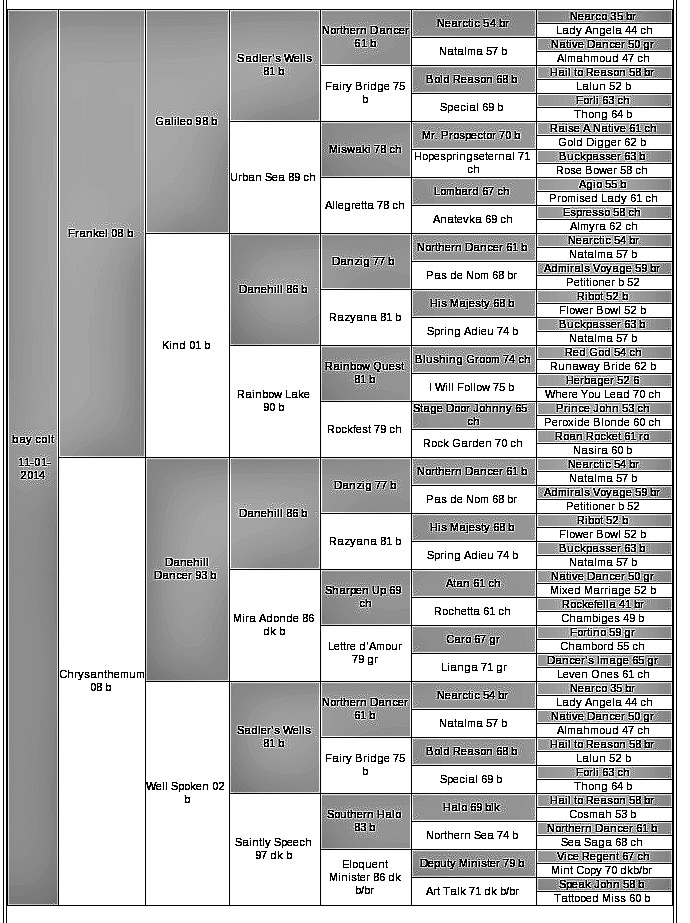
    Frankel’s first foal was born on the 11th of January.  The dam Chrysanthemum was a Group 3 winner trained by David Wachman for Coolmore connections. In truth, in terms of racing performance and pedigree Chrysanthemum was no more than a middle ranking member of Frankel’s stellar first book of mares.

    However what is far more interesting is the pedigree cross it represents.  We are by now, well used to seeing variants of the  Sadler’s Wells (and sons) by Danehill cross , the cross that reached its pinnacle with Frankel himself. It has proved hugely successful with Galileo alone having sired  8 Group 1 winners out of Danehill mares. Chrysanthemum is by Danehill Dancer out of a daughter of Sadler’s Wells and it begs the question can you have too much of a good thing?

    Sadler’s Wells and Danehill are the giant names of European breeding in recent decades. Coolmore achieved considerable success with the likes of Horatio Nelson (Danehill ex Imagine), Peeping Fawn (Danehill ex Maryinsky and Chevalier (Danehill ex Legend Maker) bred on this cross.  Given the number of high class broodmares they possess with both names in the pedigree it is perhaps unsurprising that they are considering doubling up what has worked in the past.

    They would have been encourage by the results to date for Teofilo (Galileo ex Speirbhean by Danehill) who is similarly bred to Frankel. Teofilo has made a good start to his stud career highlighted by Group 1 success for Parish Hall  (ex Halla Siamsa by Montjeu) and Irish Derby success  with Trading Leather who is out of a Sinndar mare and thus has another cross of Danzig as does Voleuse Des Coeurs (ex Vadorga by Grand Lodge). This new foal is just gone a little further in terms of duplication.

    This foal will have Sadler’s Wells 3X3, and Danehill 3X3.  In the first 6 generations Northern Dancer’s name appears 5 times and he appears once more in the 7th generation. Given that Danehill features 2 crosses of Northern Dancer’s dam Natalma, her name appears 8 times in the pedigree! If this was  a human we would be appalled, even if it was a pedigree dog we would be concerned yet when it comes to our friends the thoroughbreds we just think it’s interesting!  As regards the question, whether you can have too much of a good thing,  we will obviously just have to wait until he finishes his racecourse career to answer that one…

    Frankel's first foal
    6 generation pedigree

    Please Leave a comment