Category: Industry Issues

  • ‘Saving’ the Irish Derby…

    Alan Sweetman is proposing that the Irish Derby should become a 10 furlong race. He argues that it is now a diminished sporting and social occasion. He is right that it is a diminished occasion. He is wrong that dropping the distance by two furlongs will address the problems. The main problems with the Irish Derby lie with the Curragh management. They spent €80 million redeveloping the Curragh but don’t know how to attract crowds.

    The Irish Derby as a social occasion has completely lost its way. As a student, I remember attending when it gave those of us in baggy jumpers a chance to admire the well heeled and beautiful. It was the Irish Royal Ascot a place to be seen. That reputation is now gone. Over the past decades we have seen the Irish Derby flip flop between Saturday and Sunday slots and between day time and evening post times. What did all that tinkering achieve?
    It was a further mistake to run the Derby at the Curragh during the redevelopment phase. The temporary facilities were more akin to a point to point. It cheapened the brand. When the Curragh reopened, we had long queues that led to a lousy customer experience. Then Covid came along and crowds were banished. The memory of the Irish Derby as a must attend event became even hazier..
    Getting the crowds back should have been the priority. Instead Brian Kavanagh stated that €50 is a reasonable admission fee. He argued that it was cheaper if it was booked in advance- so that’s alright then.. Brian should be told that you can charge those premium prices for a premium event but its now just a race with no social element. They are soaking die hard racing fans. They don’t know how to appeal to racing savvy customers or the fashionable set looking for a social occasion.
    The Melbourne Cup is a must attend/must watch event despite being a two mile handicap. Crowds attend Listowel and Galway because of the atmosphere- everyone goes because everyone goes. The Curragh management need to get crowds and atmosphere back to Derby. They seem clueless as to how to do so. The great race is not in good hands.

    Champions Weekend at the Curragh and Leopardstown have outstanding cards and struggle to breach 12,000 attendees each day. I would like to see tweaks to the cards on Derby Day but realistically these changes will only appeal to a small racing cohort. There is no such limit on what a popular well marketed social event could attract.


    The race itself should not be dropped in distance. Dropping the distance will make no material difference to attendance figures and will be throwing away a century of tradition. We have a well earned reputation for producing outstanding middle distance horses and yet its being proposed that we abandon our only Group 1 for colts over 12 furlongs! International participation may have waned in the past two decades but we lived through an unprecedented period of Ballydoyle dominance. Galileo drove much of that domination and that (boring) domination is now over and we can expect competition to increase and return.

    Change because of a few unremarkable winners isn’t a good policy. Serpentine, Anthony Van Dyck, Wings of Eagles won Epsom Derbies between 2017 and 2020. You could just as easily argue that the Epsom Derby is finished based on those results…It’s not finished just as there is nothing fundamentally wrong with a 12 furlong mid Summer Irish Derby, that showcases the best of Irish breeding and training.

  • IHRB’s Curious Accounts

    In 2019, the IHRB introduced a 9 stroke limit on the jockey’s use of the whip. This year, they themselves are suffering a beating at the hands of their detractors . They have eventually posted their 2019 accounts and it seems they are intent on giving their detractors more sticks with which to batter their reputation…

    1. The missing €1.6 million:

    Their 2018 accounts were incorrect by €1.6 million (in income and expenditure) and had to be restated…….You might want to reread that sentence… It seems extraordinary that an error of this magnitude was not noticed by anyone in the IHRB (or their previous auditors) . The Comptroller and Auditor General has come on board as auditor for these accounts and it would be interesting to know what the staff of the C&AG’s office made of such a material financial mis-statement in a previous set of accounts. The excerpt from the accounts is shown below…

    note from accounts

    Interestingly, the 2019 accounts were submitted to the CRO a number of weeks ago but then returned for unspecified reasons (but not seemingly the restatement issue).

    2.Publicly funded salaries that are being kept secret

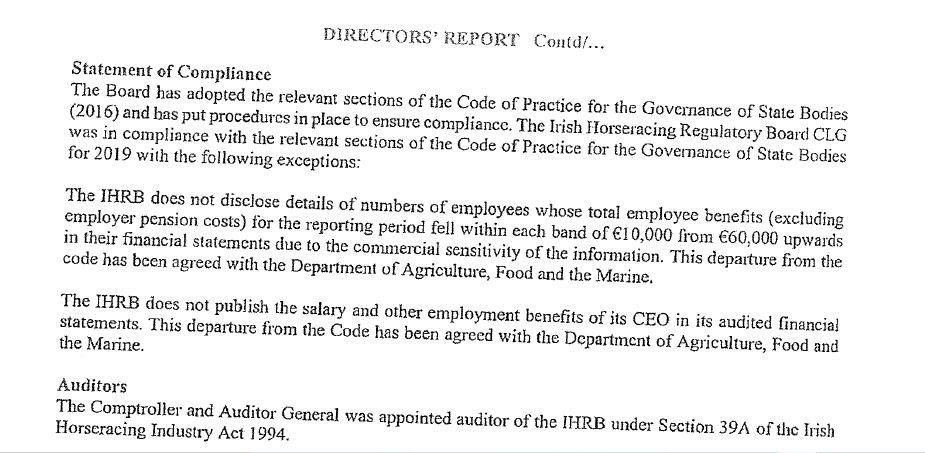
    Despite being almost entirely dependent upon public funding, the IHRB are not disclosing salary details of senior staff. It is the norm in all public sector bodies (and all PLC’s in the private sector) that the salary of the CEO is disclosed. It is remarkable that the IHRB have been allowed to refuse to disclose this salary by the Dept of Agriculture. The stated reason is due to the ‘commercial sensitivity’ of the information. This is a complete nonsense given that the organisation does not operate in a commercial sphere and there are no competitor organisations to the IHRB. I have no beef with Denis Egan but as someone whose salary comes from the public purse it should be disclosed the same as other public servants. Not disclosing the salary obviously gives rise to concerns that the real sensitivity is the embarrassment it would cause. We already have a situation in which the soon to depart Brian Kavanagh is paid a salary of c €190,000 which is well in excess of the supposed salary range for that role. HRI’s budget is a multiple of IHRB’s, yet I suspect that the salary differential is minimal (if indeed it exists). The IHRB have also been granted a derogation on the requirement to even list the number of staff in each salary band for higher earning staff. Both of these derogations are unacceptable in any public body…An FOI request to the Dept of Agriculture on the lobbying around this derogation would be interesting…

    3. The Turf Club (they haven’t gone away you know)

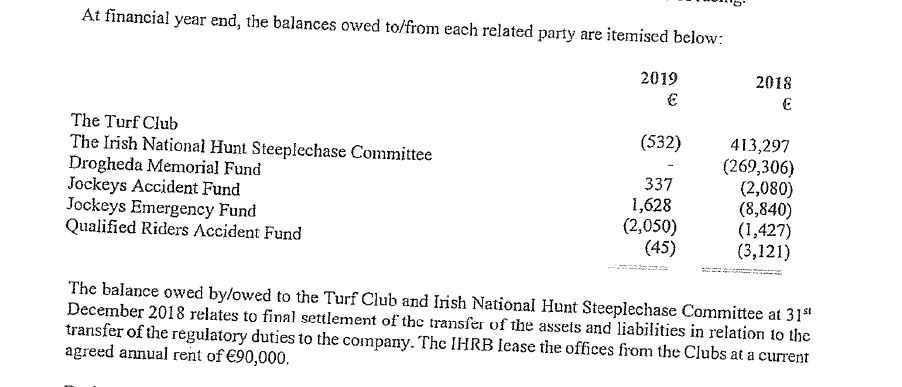
    Another interesting element of the accounts is the relationship with the Turf Club. That private members club hasn’t gone away… In 2019, €90,000 was paid in rent and it would be interesting to know why and what was involved in the payments made to and from the Turf Club/INHS relating to the transfer of assets/liabilities (see note below)..

    Final Word:

    The question has to be asked if Irish racing needs two highly paid (overpaid?) Chief Executives who are funded from the public purse. The accounts of the IHRB show a €2.8 million spend on administration with 33 staff. Rather than attacking Jim Bolger, perhaps a question for the upcoming Dail Committee could be if we need two separate bodies each with their own payroll, accounts functions, legal functions etc ? Why not absorb the integrity function into HRI? The arguments to retain the IHRB became harder to sustain when they seem unwilling to let the taxpayer know what salaries they are paying themselves and when they couldn’t correctly account for what they claimed to spend…..

  • Book Review: “The Black Horse is Dying” by William Jones

    This is an important book. The issue of Performance Enhancing Drugs (PED’s) in Irish racing is now a hot topic following recent articles by David Walsh in the Sunday Times and Paul Kimmage in the Sunday Independent. Both journalists have rightly credited the work of William Jones in documenting the issue. William Jones is a former journalist who spent a number of years working with Coolmore before becoming a whistleblower about what he saw as unacceptable practices in Coolmore. These were documented in his first book ‘The Black Horse of Coolmore”, that led to a lengthy and bitter legal dispute with Coolmore.

    His second book is especially damning in its portrayal of American racing. Reading the litany of positive tests/infringements in horses with US trainers such Bob Baffert, Steve Asmussen, Doug O’Neill, Jorge Navarro and Jason Servis is both shocking and dispiriting. More concerning is the ongoing medication that is normal and legal within US training circles. A revealing extract from the medication history of seven Baffert horses who died at Hollywood Park, shows just how far removed US training is from the ideal of trainers using just water, hay and oats. He questions what he sees as the hypocrisy of European trainers and owners who follow the ‘when in Rome approach’ and run their horses on Lasix in the States despite condemning their use in Europe.

    Lest, we get complacent in Ireland and the UK, Jones details various drug cases that occurred here and the trainers and vets who were sanctioned. He covers the high profile UK case involving Nicky Henderson and the Queen Mother’s horse Moonlit Pass. The book is revealing in highlighting inconsistencies in approach by the Irish authorities. The lack of accountability of the IHRB who are not covered by Freedom of Information legislation despite received c.€9 million in taxpayers money is an interesting anomaly that he raises. The author was instrumental in getting the Veterinary Council to change its rules about having fitness to practice hearings in public. He has been meticulous and no doubt an irritant to the authorities and yet Irish racing owes him a huge debt.

    This book is not perfect; it could have done with better editing, the details of his legal battles and the repeat of some of his grievances with Coolmore might have been better left for another work. His belief that the UK administration and testing regime is more effective and impartial than the Irish system is also debatable. His criticism of some individuals can at times seem unduly harsh but he is a skilled polemicist and gets a lot right.

    Reading this book it is easy to conclude that racing and breeding is ignoring a serious animal welfare/PED crisis. He covers the unacceptable behaviour of big bookmaker in exploiting problem gamblers and given the reliance of racing on these same bookmakers it is another area of concern. Whistleblowers are rarely thanked for the difficulties they cause those in power. If you want to thank Mr Jones you can purchase his book via Amazon or some independent booksellers. I urge you to do so….https://www.amazon.com/Black-Horse-Dying-Corruption-Exploitation/dp/1838536523

  • Covid shows the need to plan for Artificial Insemination

    Despite the shut down of so many industries, the horse breeding season was able to continue in the UK, Ireland and France. It benefits from its classification as an agricultural activity. Agricultural activity is of course essential to ensure a stable food supply.  However, thoroughbred breeding isn’t about food production and in a possible future pandemic,  travelling thousands of mares to stallions in their own countries or overseas may not be allowed. They say you should never let a crisis go to waste and now is the time to agree on a set of rules to cover the use of Artificial Insemination in horses.  AI is by far the best option to ensure that breeding can proceed as normal in the event of a future disease outbreak (human or animal). The move to AI should also be linked to new stallion book quotas such as the upcoming US limit of 140 mares.

    The Benefits of Artificial Insemination

    Compared with live covers, artificial insemination offers the following benefits:

    1. Cost efficiencies
    2. Environmentally friendly (transport of a straw versus a mare)
    3. Improved disease control (reduction in animal and human movements)
    4. Improved choice for breeders

    With a global pick of stallions, even for low value mares, we can reverse the narrowing of the equine gene pool. It is this narrowing of the gene pool which has prompted the proposed US cap of 140 mares per stallion. The ‘traditionalists’ chief concerns have been

    a) the fear of huge crop sizes

    b) a reduction in stallion diversity

    c) the practical issue that foals conceived by AI are not eligible for inclusion in the stud book

    d) danger that new stallions won’t get a chance as stallion semen is used after the death of a stallion

    These fears can be overcome. Taking these issues in turn:

    a) Huge crop sizes are already a reality (Soldier of Fortune covered 341 mares in 2017 and 261 in 2019). The marketplace will find a level at which demand (finite) will equal the new level of supply (almost infinite).  After an adjustment period, I do not envisage the top stallions greatly exceeding some of the current crop sizes. Better still, a cap can be put in place in terms of the maximum number of foals registered for each sire in a given year. The proposed US cap of 140 is a useful starting point- see my previous post https://www.montjeu.com/140-a-useful-restrictiona-straw-in-the-wind/ for a full discussion on that issue.

    b) Available stallion options will increase. To take an example, Irish breeders will have ready access to sons and grandsons of Sunday Silence or AP Indy, without having to ship the mares to Japan or the US.

    c) The rules around registrations are not unalterable and previously Kentucky considered allowing AI during a disease outbreak. Faced with the prospect of a dramatically curtailed or non-existent foal crop or a legislative change, what do you think will happen?

    d) A rule can be introduced that straws can only be used for 2 months after the death of a stallion. This avoids a situation where Galileo is still champion sire in 2050 🙂

    Conclusion

    AI works successfully for other horse breeds such as quarter horses. The use of AI, linked to quotas can stop the narrowing of the gene pool. This is what the American Jockey Club is trying to achieve with its cap of 140 mares. Breeding needs to work on its green credentials and the reduction in road and air miles due to the elimination of mare transport will be significant.

    Covid has changed everything. However there were previous disease outbreaks such as foot and mouth that also threatened the viability of the current breeding system. We should plan for a new system now before some future disease outbreak threatens the loss of an entire foal crop. Lenin once said “there are decades when nothing happens and there are weeks when decades happen”. The last few weeks meet that description. AI is still unthinkable for many, but once it has happened, people will wonder what all the fuss was about. The benefits outweigh the costs. The world has changed. Breeding needs to change….